


Why most AI apps never ship

Open any AI app builder and you can have something running in under a minute. A login page, a dashboard, a working prototype: all of it generated from a sentence or two of plain language.
Almost none of these projects become real products.
Not because the ideas are bad, and not because the code does not run. It is because generating an application and shipping one are different problems, and most of the AI industry has optimised heavily for the first while treating the second as an afterthought.
Generation is not the hard part anymore
This is worth saying plainly: the technical challenge of producing working code from a description has largely been solved. Modern models are genuinely good at this. Ask for a form, a basic app, an e-commerce flow, and you will get something that runs, often on the first try.
That is a real achievement, and it has changed who gets to start building. People with no formal training in software can now produce something functional in an afternoon. The barrier to entry that used to keep building locked behind years of learning syntax has come down substantially.
But starting and finishing are not the same milestone. A working prototype tells you the model can write code. It tells you nothing about whether that code can handle real users, real data, or real failure conditions. Most AI tools stop at the point where the interesting problems begin.
What “production-ready” requires
A demo needs to work once, in front of one person, under ideal conditions. A production application needs to keep working for many people, under conditions nobody planned for.
That gap shows up in specific, predictable places. Authentication needs to handle account recovery, session expiry, and the edge cases of real user behaviour, not just a login form that works for the person who built it. Payment flows need to handle failed transactions, partial refunds, and the regulatory requirements of wherever the business operates. The application needs a deployment pipeline, monitoring for when something breaks, and a way to fix that thing without taking the rest of the system down.
None of this is exotic. It is the standard list of concerns that any experienced engineering team works through before calling something done. What has changed is who is now expected to handle it. AI tools have made the first 80% of a software project dramatically faster, while leaving the remaining 20% almost untouched. That remaining 20% is where the actual difficulty of shipping software has always lived.
Why this gap persists across the industry
The incentive structure explains a lot of this. A tool that gets a user from idea to working demo in sixty seconds produces an immediately impressive result. A tool that spends real engineering effort on deployment infrastructure, security review, and production monitoring produces something less visually dramatic but considerably more useful. The industry has, understandably, optimised for the metric that is easiest to show in a thirty-second clip.
There is also a deeper, more structural reason. A large language model generates code by predicting plausible continuations based on its training and the context available to it. It does not hold a persistent, verified model of a specific application's architecture across an entire build. That works fine for a single feature in isolation. It becomes a liability as a project grows in complexity, because the assumptions the model makes about how different parts of the system relate to each other are not being checked against reality. The result is code that looks correct and frequently is not, in ways that only surface once real usage begins.
Builders are left to discover this gap on their own, usually after they have already invested weeks into a project that cannot survive contact with real users.
Where HyperDev fits into this
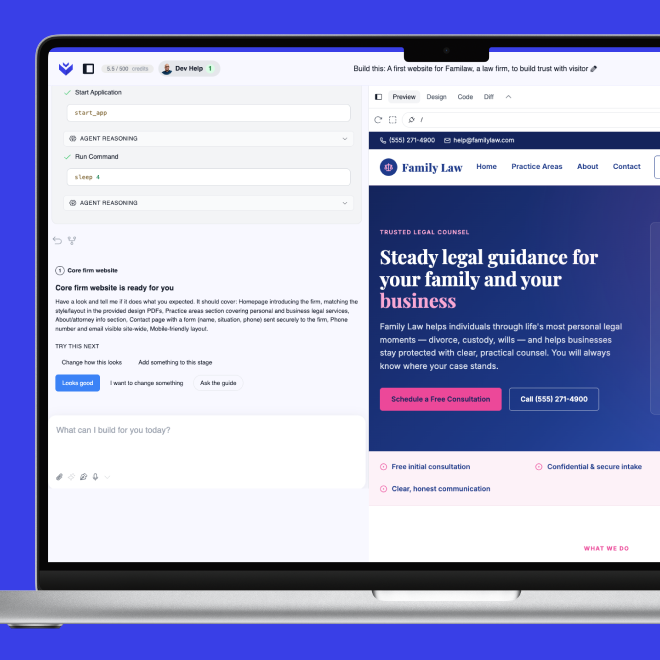
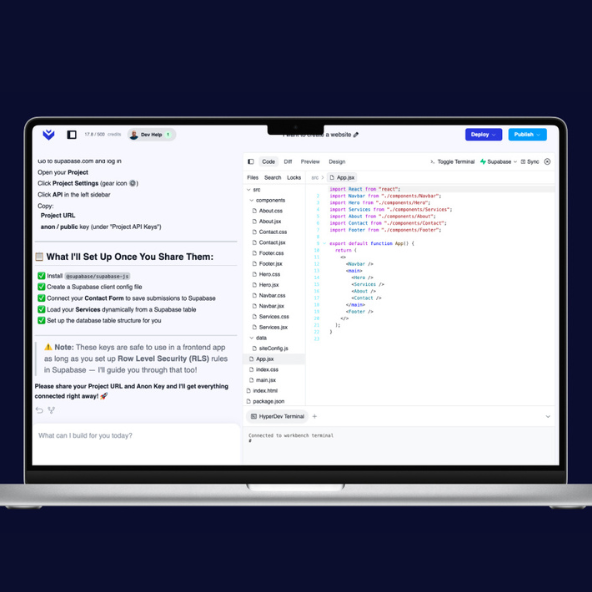
This is the gap we built HyperDev to close. Not the demo-to-prototype step, which the broader AI industry has already made fast, but the part that comes after: the architecture holding together across an entire build, authentication and payments that are handled as production infrastructure rather than something to prompt your way through, and direct access to a certified developer through Dev-in-the-Loop when a problem genuinely needs human judgement.
The aim is not to make the first sixty seconds more impressive. It is to make the project still standing in month three.
What actually separates shipped products from abandoned ones
The tools for getting started have never been more capable. The tools for finishing have lagged behind, and that gap is the reason most AI-generated projects stall somewhere between an impressive demo and a real product. Closing it is not a matter of better prompting. It requires building for the parts of software development that do not show up in a screen recording.
Ready to build something that lasts?
.png)




%201.png)
