


Why AI-generated code breaks down over time and how HyperDev fixes it

AI coding tools have made it genuinely fast to start building. You describe what you want, and functional code appears in seconds. For a lot of builders, that first session feels like a breakthrough. But there is a problem that almost everyone encounters once they push past the initial prototype.
The code that looked clean and logical at the start becomes harder to reason about with every new prompt. Something that worked in session one breaks in session three. Attempts to add a feature introduce errors in parts of the application that should not be affected.
Eventually, the codebase reaches a point where neither the builder nor the AI can make confident changes without something going wrong. This is not a prompting issue. It is a fundamental limitation of how large language models generate code, and it is the core problem HyperDev was designed to solve.
Why code degrades over multiple prompts
A large language model does not hold a persistent understanding of your application. Each time you send a prompt, the model is working from whatever context fits within its window. It generates the most plausible next block of code based on that input without a durable model of the system it is contributing to. This works reasonably well when a project is simple and contained.
As complexity grows - more components, more interdependencies, more logic - the model starts making assumptions about structure and relationships it cannot fully verify.
Those assumptions stack up. The code remains plausible at a surface level while becoming harder to maintain underneath. This is what code degradation looks like in practice. It is not a single catastrophic failure. It is a gradual drift that compounds across sessions until iteration becomes expensive and fragile.
Better prompting helps, but it does not solve the problem
Many builders respond to this by trying to improve how they communicate with the AI. More context, more specific instructions, more structured prompts. These approaches can reduce the rate of degradation, but they cannot eliminate it. The underlying constraint is architectural. Context windows are finite. Attention quality degrades across long sequences. The more sophisticated the application, the more information the model would need to hold simultaneously to generate reliably - and that information cannot always fit. Optimising prompts is working around a ceiling. It does not raise it.
How Guided Mode approaches this differently
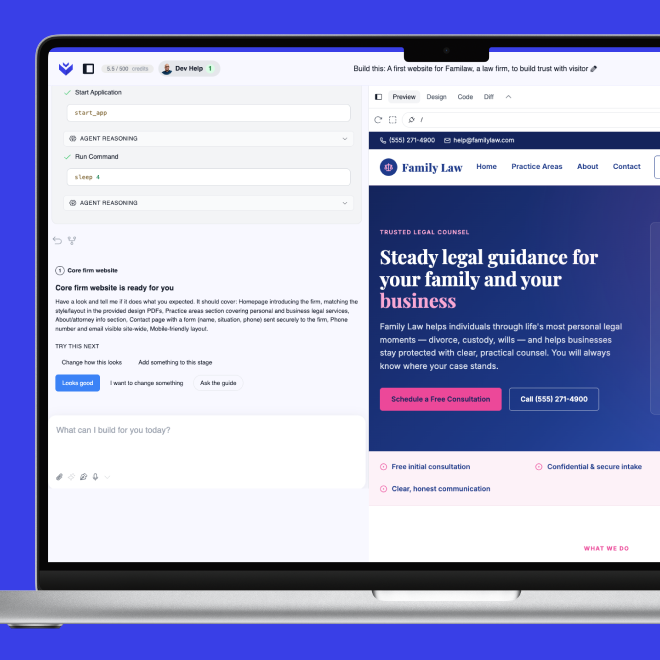
HyperDev's answer to this problem is Guided Mode - a proprietary AI layer that sits between the user and the underlying model output. Rather than asking a general-purpose LLM to reconstruct your application's logic from scratch on every generation, Guided Mode drives your session by suggesting granular changes in order to maximise the efficiency in reaching the goal of creating a high quality application in the shortest time and lowest cost.
This is also why Natural Language Rules are central to how HyperDev works. Instead of freeform prompting that produces unpredictable results, rules let you define intent clearly and consistently. Guided Mode enforces those rules during generation, ensuring new code fits within the structure you have already established rather than working against it. The result is a codebase that stays readable, editable, and maintainable across the full lifecycle of a build, not just the first session.
Getting past the shipping wall
Maintainable code is only part of what it takes to ship a real application. User authentication, payment systems, and deployment configuration are consistent sticking points for builders using generic AI tools - not because the AI cannot generate the relevant code, but because getting it right, securely and reliably, requires a level of technical depth that most builders are still developing.
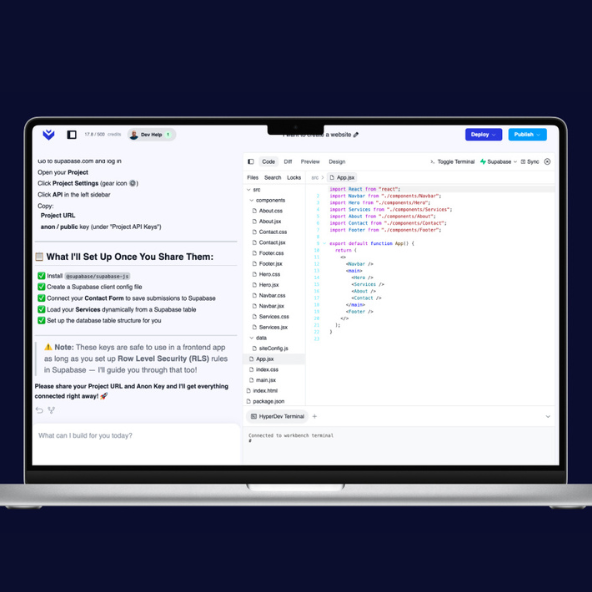
HyperDev handles authentication and payment infrastructure natively inside the platform. These are not things you need to configure or prompt your way through from scratch. They are built into the production-ready foundation your application runs on.
And for complex issues that still require human judgement - the edge cases and production bugs that no AI tool handles perfectly - HyperDev's Dev-in-the-Loop feature connects you directly to a certified developer who can step into your live project and resolve the problem without breaking anything else.
The gap HyperDev is built for
Most AI tools are optimised for the speed of the first generation. HyperDev is built for what comes after - the iteration, the debugging, the infrastructure, and the long-term maintainability that turning a prototype into a real application actually requires. The barrier to starting a software project is lower than it has ever been. The barrier to finishing one is still real. That is the gap HyperDev exists to close.
Ready to build something that lasts?
.png)



%201.png)
