


Why your AI-built app breaks after just a few prompts (and how to fix it)

Building an app with AI often starts the same way. You describe what you want to build. The AI tool generates a landing page, a dashboard, or a working feature in minutes. A few prompts later, you have something that feels surprisingly close to a real product.
Then things start to change.
A feature that worked yesterday suddenly stops working. A new update causes problems somewhere else in the application. Fixing one issue creates another. Before long, you are spending more time troubleshooting than building.
If this sounds familiar, you are not alone. One of the most common frustrations that builders face is watching an AI-generated project become harder to manage over time. Understanding why AI code breaks is the first step towards fixing it.
What code degradation looks like in practice
Most builders do not notice the problem immediately. The first few prompts usually produce good results. The application behaves as expected and progress feels fast. The AI tool appears to understand exactly what you are trying to achieve.
The challenge emerges as the project grows.
Each new feature introduces more complexity. More pages need to work together. More logic needs to remain consistent. More decisions need to be carried forward from previous prompts.
This is when builders begin noticing unexpected behaviour.
The AI-built app keeps breaking in ways that are difficult to predict. Changes that should only affect one part of the application begin affecting other areas. Features that worked previously break and need to be fixed again.
The application still runs but maintaining it becomes increasingly difficult. This gradual decline in consistency is what we call code degradation.
Why better prompting does not solve the problem
When projects start behaving this way, many builders assume they need to improve their prompts. They provide more context. They write longer instructions. They spend more time explaining exactly what should happen.
These approaches help in the short term. But they do not address the underlying issue.
Most AI coding tools generate code based on the information available during a single interaction. As applications become more sophisticated, keeping track of every relationship, dependency, and design decision becomes harder with each prompt. The tool starts making assumptions that do not align with the structure already in place.
This is why builders searching for ways to fix unmaintainable AI code find that prompting alone is not enough. The challenge is not generating code. It is maintaining consistency across dozens of iterations.
Why the problem gets worse as projects grow
A simple prototype can survive a few inconsistencies. A real application cannot. As builders add user authentication, payment functionality, dashboards, integrations, and new workflows, the number of moving parts increases significantly.
Each addition creates new relationships within the app. A change to one area can have consequences elsewhere. Small issues become harder to identify. Testing becomes more time-consuming. Progress slows down.
For founders building products, this delays launches and makes it harder to reach customers. For students building portfolio projects, it can turn a promising idea into one that never gets finished.
Getting started is no longer the hard part. The difficulty is maintaining momentum once the application becomes more sophisticated.
How Guided Mode approaches the problem
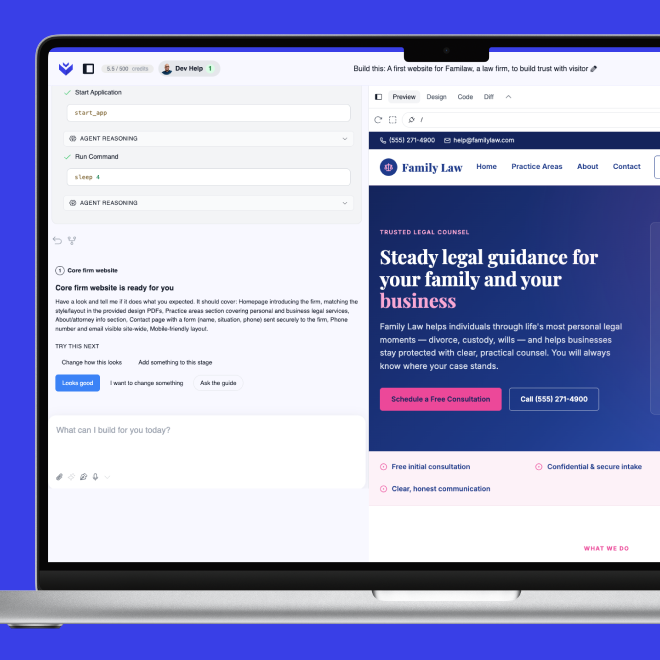
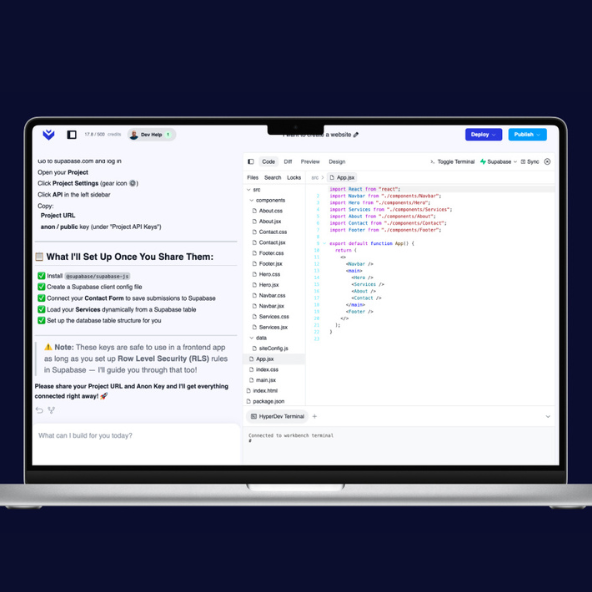
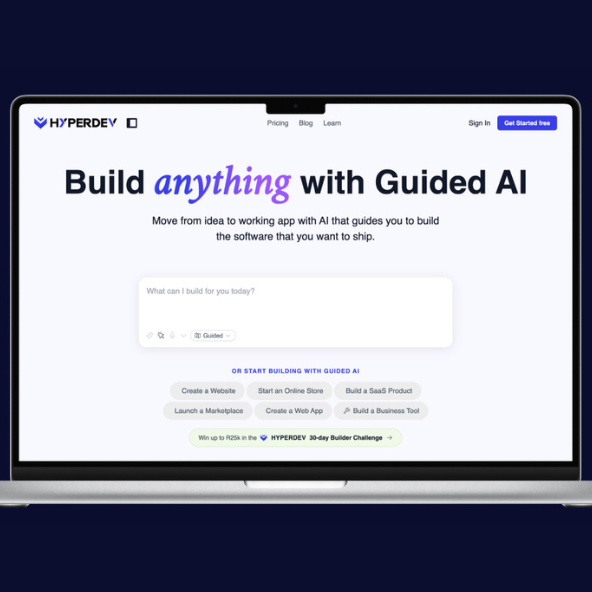
HyperDev was built around this challenge. At the centre of the platform is Guided Mode, HyperDev's proprietary AI layer that sits between the user and the underlying language model.
Rather than asking a general-purpose LLM to reconstruct your application's logic from scratch on every generation, Guided Mode drives your session by suggesting granular changes in order to maximise the efficiency in reaching the goal of creating a high quality application in the shortest time and lowest cost.
This works alongside Natural Language Rules. Builders define their requirements and constraints in plain language, and Guided Mode applies those rules during generation so that new code aligns with the structure that already exists.
The goal is not simply to generate working code quickly. It is to maintain a codebase that stays understandable, editable, and easier to improve over time.
The gap HyperDev is built for
AI has dramatically lowered the barrier to building software. What remains difficult is maintaining a project through repeated iterations.
The builders who successfully launch products and complete projects are rarely the ones who generate the first version fastest. They are the ones who keep improving their applications without losing control of the underlying code.
The first prompt is easy. Everything after it is what separates a finished product from an abandoned one.
Ready to build something that lasts?
.png)



%201.png)
