


Future-proofing your business

Future-proofing your business starts with a smaller question than you think
Most conversations about AI and the future of work start with a big, slightly frightening question: which jobs will disappear?
For a founder or small business owner, that may not be the most useful place to start. A better question is much smaller and much more immediate: what is the one task your business does every week that takes longer than it should?
That task, whatever it is, may be where AI earns its keep.
Not as a strategic transformation with a steering committee and a twelve-month roadmap, but as a practical tool that removes friction from something you already do. Instead of trying to work out what AI means for every part of the business at once, founders can start with one problem and see what changes when they approach it differently.
The shift worth paying attention to is not simply that AI can write code or draft emails. It is that AI has collapsed the distance between having an idea and having something real.
A founder with a clear picture of what their business needs no longer has to wait for a developer to build a first version before they can test whether an idea works. Internal tools, customer-facing prototypes, simple automations and the kinds of software that used to sit permanently on a “nice to have” list because nobody had time to build them are increasingly within reach of the person who actually understands the problem.
That does not remove the value of technical skill. It changes where that skill is most useful.
Judgement about what to build, how to prioritise it and when something is genuinely ready for customers remains human. What has changed is that a non-technical founder can explore an idea much earlier, without first needing a large development budget or a place in someone else's project queue.
Three ways to start
Future-proofing does not require an overhaul. It requires picking a starting point and being consistent about it.
- Start with something low-risk and high-friction: An internal reporting tool, a client onboarding form or a simple dashboard that currently lives across three different spreadsheets can all be useful starting points. These are practical projects where the potential benefit is clear and the cost of getting something wrong is relatively contained.
- Make the process visible within your team: Show people what a first version, built quickly with AI, actually looks like. Resistance to new tools can come from not knowing what they can realistically do. A working prototype can make the potential much more tangible than another presentation about AI.
- Measure time, not sentiment: Track how long a task takes before and after introducing an AI-enabled tool. The point is not to use AI because it is new. It is to establish whether it genuinely makes the business more efficient, improves an experience or frees people up to focus on higher-value work.
Building without waiting
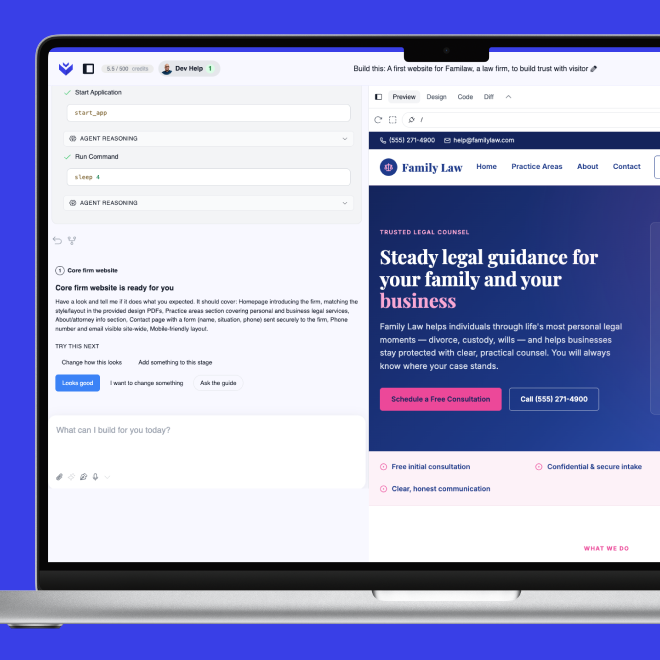
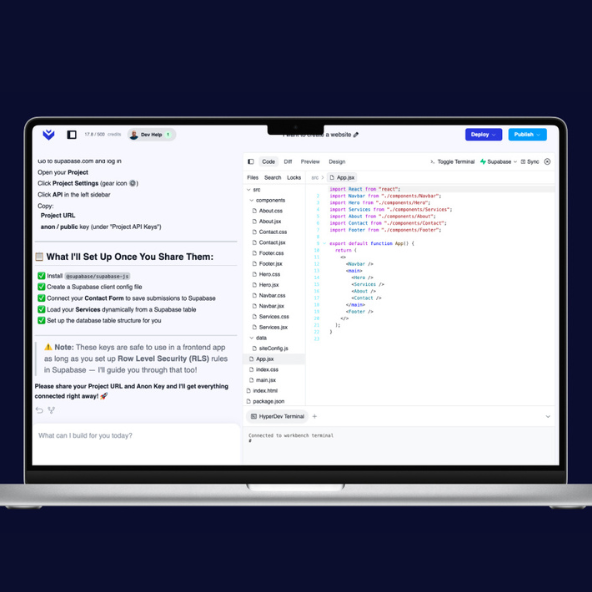
This is the gap HyperDev is built to address. Rather than requiring a founder to specify every technical detail, HyperDev allows users to describe what their business needs and turn that idea into a working application. For someone whose expertise lies in understanding their customers rather than writing code, that can shorten the distance between identifying a problem and testing a solution.
The value is not simply in producing software faster. It is in giving businesses a way to explore ideas that might otherwise remain on a list of things they would like to build when they have more time, more budget or access to a developer.
AI-powered development does not mean every business needs to become a software company. It means more businesses can use software to solve problems that previously felt too expensive, time-consuming or technical to tackle.
The businesses that benefit most may not be the ones that launch the biggest AI initiative. They may simply be the ones that get comfortable using AI to solve small, practical problems, then keep building from there.
Future-proofing your business can start with something much smaller than you think.
.png)





%201.png)
